Issue Brief: The TPNW and the NPT

On October 24, 2020, the Treaty on the Prohibition of Nuclear Weapons (TPNW) reached the 50th ratification needed for it to become legally binding. This paper looks at possible convergences between the NPT and the TPNW: How can the international community ensure complementarity between the two treaties? How can states parties to the NPT and the TPNW jointly advance nuclear disarmament, to their mutual benefit? And how could such cooperation be constructively reflected in the outcome of the 10th NPT Review Conference?
Abstract

The treaty will enter into force after 90 days on January 22, 2021, and the Secretary-General of the United Nations will convene a first meeting of states parties within one year. Also in 2021, states parties to the Treaty on the Non-proliferation of Nuclear Weapons (NPT) are scheduled to meet for the 10th Review Conference which was postponed from May 2020 because of the COVID-19 pandemic. Both meetings will tackle the crisis in nuclear disarmament and arms control – but from different angles.
Authors

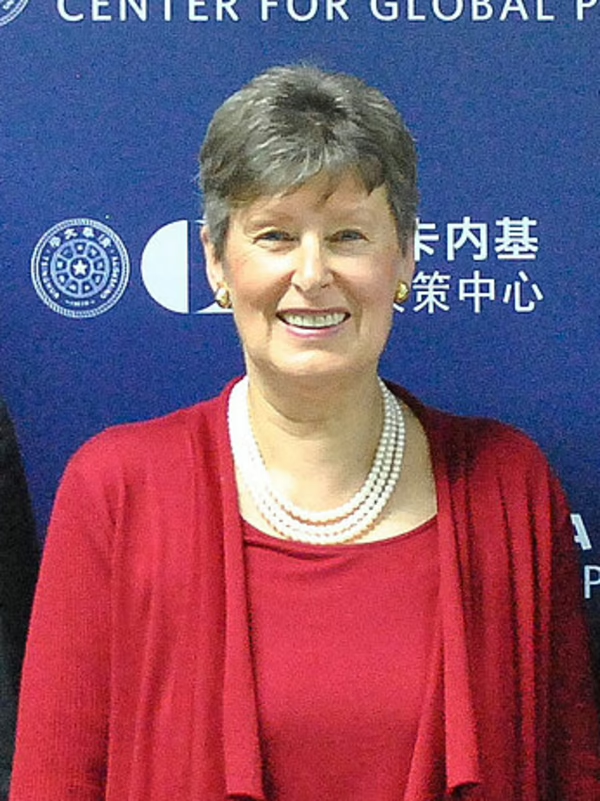
  • Angela Kane

    is a Senior Fellow at the Vienna Center for Disarmament and Non-Proliferation. In addition, she holds a number of other functions, inter alia at the International Institute for Peace in Vienna, the Paris School of International Affairs, and the Tsinghua University in Beijing. Kane has served in many notable positions during her career at the United Nations, lastly as the UN High Representative for Disarmament Affairs.

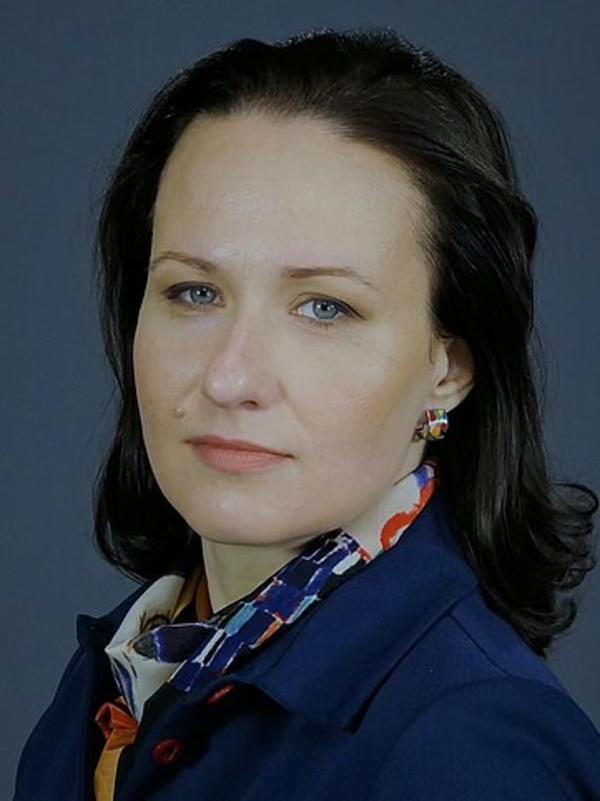
  • Anastasia Malygina

    has considerable experience in teaching arms control, disarmament and nonproliferation. In 2007, she participated in the Summer School on International Security held by Moscow-based PIR-Center and contributed to several research projects coordinated by this NGO. In 2013, Anastasia joined a network of Russian university professors who are working together to implement various nonproliferation training and outreach activities in Russia. In February-April 2016, Anastasia was a Visiting Scholar at the Center for Non-Proliferation Studies (CNS) in Monterey (USA). Anastasia is a member of the Working group "Nuclear Disarmament in Policy and International Law" at the Alva Myrdal Centre for Nuclear Disarmament at Uppsala University (Sweden). She has written and spoken on strategic stability, nuclear nonproliferation, and strengthening the BWC regime.